Blog
Niacinamide vs Vitamin C: Which Is Better for Your Skin?

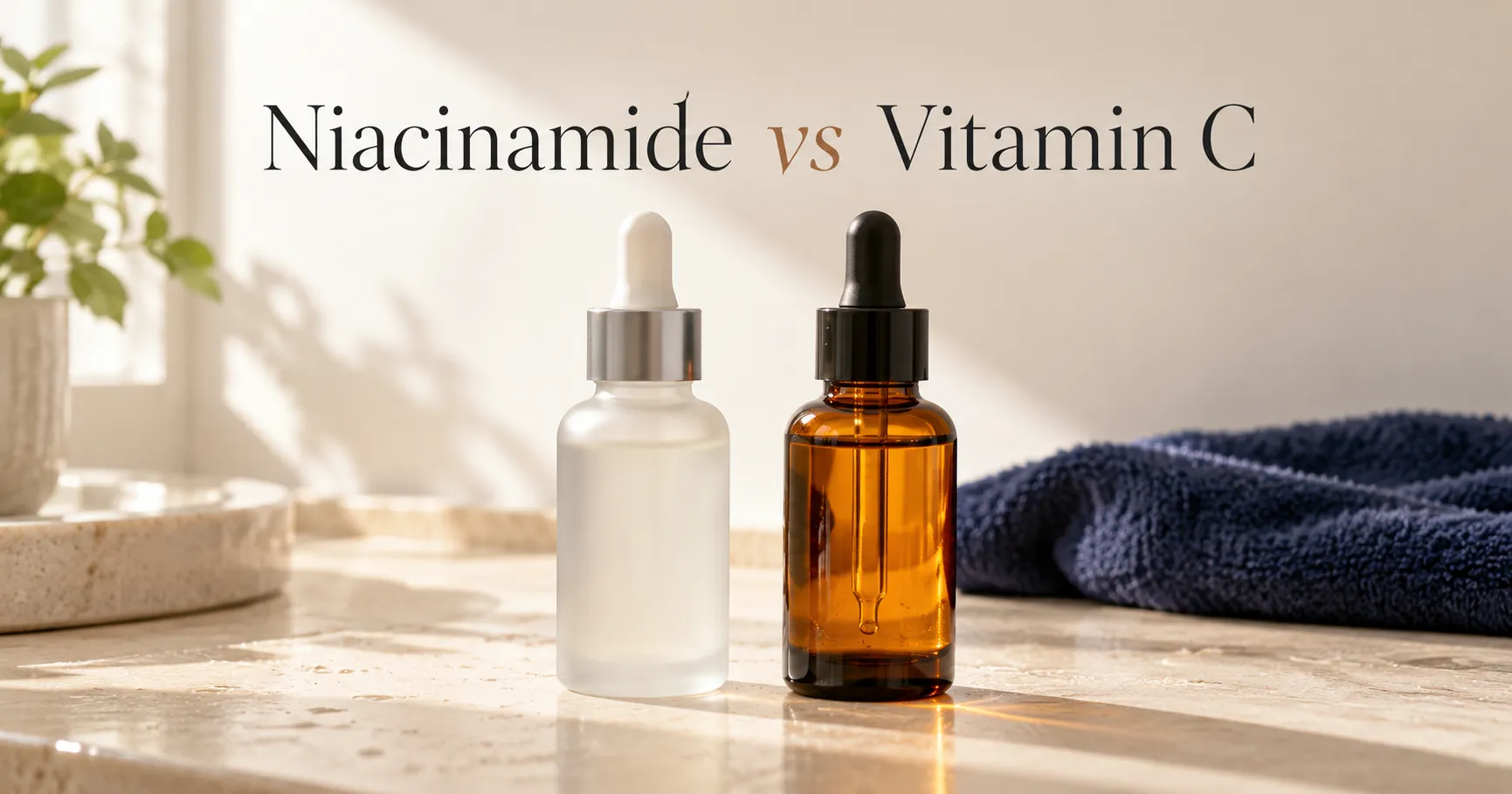
Choose niacinamide for oiliness and barrier support; consider vitamin C for antioxidant support and uneven tone. Neither wins for everyone. Both may help dark marks, but your skin’s tolerance and the complete formula matter more than a fashionable ingredient or a higher percentage.
This comprehensive comparative serum guide compares niacinamide vs vitamin C for US and UK readers, using published research and current product listings. You do not need both ingredients to build a useful routine.
Editorial and health note: This guide has not undergone medical review or hands-on product testing. It provides general information, not diagnosis or treatment. Persistent acne, unexplained pigmentation or a changing skin lesion needs professional assessment.
Niacinamide vs Vitamin C at a Glance
| Question | Niacinamide | Vitamin C |
|---|---|---|
| What is it? | Vitamin B3, also called nicotinamide | Ascorbic acid or a vitamin C derivative |
| Main reasons to consider it | Barrier support, moisture retention and oiliness | Antioxidant support, uneven tone and fine lines |
| Can it help dark spots? | May reduce excess pigment transfer | May influence excess melanin production |
| Can it irritate? | Yes, despite often being well tolerated | Yes, especially acidic formulas |
| When can you use it? | Morning or evening | Morning or evening |
| Does it replace sunscreen? | No | No |
What Do These Ingredients Actually Do?
Niacinamide supports production of ceramides and other barrier lipids, helping skin retain moisture. Research on skin lipids supports this function, but a serum cannot resolve every cause of dryness.
It may also reduce oiliness. A 2006 study tested 2% niacinamide in Japanese and US groups; improvements differed between the oil measurements and populations. Less shine can make pores look less noticeable, but pores do not permanently close.
Vitamin C helps counter free radicals associated with environmental exposure and supports collagen production. DermNet explains that stability and skin absorption influence its effectiveness. Applying a serum does not provide sunscreen protection.
Both ingredients may improve uneven pigmentation through different mechanisms. That makes both reasonable options for some dark marks, without establishing that one is always faster or that combining them doubles the benefit.
Which Is Better for Your Skin Type?
| Your main concern | A reasonable starting point |
|---|---|
| Excess shine | Consider a lightweight niacinamide formula. |
| Dryness or dehydration | Consider a moisturiser containing niacinamide, glycerin and ceramides. |
| Dullness or sun-related uneven tone | Consider vitamin C if your skin tolerates it. |
| Sensitive or easily irritated skin | Prioritise a tolerated, fragrance-free routine before adding actives. |
| Painful, persistent or scarring acne | Seek appropriate acne treatment; neither cosmetic serum is a complete treatment plan. |
Skin type and skin concern are different. Oily skin can also be dehydrated. If your skin currently burns or peels, adding another active may make choosing the right product harder from Daraz Serum.
For “glowing skin”, first ask what is missing: hydration, smoother texture or a more even tone. An expensive brightening serum may add little if your main problem is an inadequate moisturiser.
Niacinamide or Vitamin C for Dark Spots: What Does Research Show?
Flat brown marks after breakouts may be post-inflammatory hyperpigmentation. Raised or indented acne scars involve structural changes; neither serum reliably removes them. Melasma and persistent patches may need a diagnosis.
| Evidence | Findings and limitations |
|---|---|
| Hakozaki and colleagues, 2002, British Journal of Dermatology | An 18-participant comparison tested 5% niacinamide moisturiser against its vehicle. A separate tanning study involved 120 participants. Pigmentation improvements were reported after four weeks. This was not a niacinamide-versus-vitamin-C trial. |
| Correia and Magina, 2023, Journal of Cosmetic Dermatology | A systematic review included seven publications and 139 volunteers. It reported benefits for pigmentation and photoageing, but could not establish the ideal vitamin C concentration. Further research was recommended. |
The niacinamide research involved industry-affiliated researchers. The vitamin C review found similar hydration improvement with vitamin C and placebo, showing why the product base matters. Separate studies cannot establish a universal winner.
A “vehicle” is the product base without the ingredient being tested. Comparing an active formula with its vehicle helps distinguish an ingredient’s contribution from the moisturising effects of the base. Small studies can provide useful clues, but they do not predict how every skin tone, concern or commercial product will respond. Look for research on the finished formula when available, rather than assuming a study of one cream proves the claims of every serum containing that ingredient.
How to Choose the Right Strength and Formula
Is 10% Niacinamide Better Than 5%?
Not automatically. Benefits have been reported with 2% and 5% formulations. A higher percentage does not prove better results. Your moisturiser may already contain niacinamide, making another serum unnecessary.
L-Ascorbic Acid or a Vitamin C Derivative?
L-ascorbic acid is a well-studied form, often formulated at a low pH. Harvard Health discusses clinical formulas using 10–20%, but that range is not a requirement for everyone.
Derivatives include ascorbyl glucoside and tetrahexyldecyl ascorbate, often shortened to THD ascorbate. Their percentages are not interchangeable with L-ascorbic acid percentages. A review of vitamin C derivatives highlights the importance of stability, delivery and evidence; a stable ingredient is not automatically more effective.
Compare the Whole Product
A serum with a familiar active can still feel very different from another product containing the same percentage. Texture, fragrance, solvents and accompanying ingredients all affect whether it fits your routine. For example, someone with dry skin may prefer a moisturising cream, while someone who dislikes heavy layers may prefer a lighter serum. Those are practical preferences, not evidence that one texture delivers better clinical results. If your existing routine works comfortably, there is no need to replace it simply to follow an ingredient trend.
Seven Essential Checks Before Buying
- Concern: Choose the problem you want to address first.
- Ingredients: Read the complete formula, including fragrance and other actives.
- Strength: Avoid choosing solely by the largest percentage.
- Tolerance: Consider your previous reactions.
- Packaging: Check protection, storage directions and expiry information.
- Directions: Follow frequency and compatibility instructions.
- Budget: Compare bottle size, local price and delivery costs.
Niacinamide and Vitamin C Products for US and UK Readers
These are examples selected for their labelled formulas and regional listings, not a ranking based on personal testing. Prices below were retrieved on 14 October 2026. They are listed prices, not guaranteed checkout totals or stock confirmations. Promotions, shipping and US sales tax can change what you pay.
| Product and size | Formula to compare | US listing | UK listing |
|---|---|---|---|
| Paula’s Choice 10% Niacinamide Booster, 20 ml | Concentrated niacinamide booster; higher strength is not proof of superiority | $53, Sephora | £52 regular price, Paula’s Choice |
| The INKEY List Niacinamide Serum, 30 ml | 10% niacinamide with hydrating ingredients | $13, brand website | £12, brand website |
| The Ordinary Niacinamide 10% + Zinc 1%, 30 ml | Follow its instruction to separate vitamin C into another routine | Check current US price | Check current UK price |
| Geek & Gorgeous C-Glow, 30 ml | 15% ascorbic acid, vitamin E and ferulic acid | $14.90, US website | £11.95, UK website |
| CeraVe Skin Renewing Vitamin C Serum, 30 ml / 1 fl oz | 10% pure vitamin C; check regional ingredient labels | $26.12, Walmart | Check current Boots price |
| SkinCeuticals C E Ferulic, 30 ml | 15% L-ascorbic acid with vitamin E and ferulic acid; regional formulas may differ | $185, brand website | £169, brand website |
| Medik8 C-Tetra Luxe, 30 ml | Oil-based formula with 14% THD ascorbate | $70, US website | £62, UK website |
| Timeless 20% Vitamin C + E Ferulic Acid Serum, 1 fl oz | Higher-strength ascorbic acid option | $27.95, brand website | Checked listing says unavailable to UK/EU customers |
“Check current price” means the price was not reliably retrievable, rather than an estimate or currency conversion.
Compare the cost of the amount you will actually use, not just the bottle price. A larger bottle may be poor value if you cannot finish it within the stated period after opening. On marketplace listings, check the seller as well as the product name. Match the size, regional ingredient list and return terms before ordering.
For a simpler moisturising option, CeraVe PM Facial Moisturizing Lotion lists niacinamide, ceramides and hyaluronic acid. The manufacturer page reviewed does not publish a niacinamide percentage, so a claim of “4%” is not established.
C-Glow’s manufacturer does not recommend its acidic formula for sensitive, redness-prone skin. Its storage guidance also differs from some other serums. Check the specific bottle’s instructions rather than treating every vitamin C product alike.
How Can You Tell If a Vitamin C Serum Has Oxidised?
Air, light and heat can affect vulnerable vitamin C formulas. However, colour alone is not a universal test of potency or safety. SkinCeuticals explains that its products can vary in colour and that changes do not necessarily mean loss of effectiveness.
| What you notice | What to do |
|---|---|
| Clear, pale yellow or champagne colour | Compare with the manufacturer’s normal colour range; appearance alone does not prove freshness. |
| Amber or darker than when opened | Check storage, opening date and brand guidance; do not apply a universal colour cutoff. |
| Unexpected smell, texture or separation | Pause use and ask the manufacturer whether the change is expected. |
| Expiry or period-after-opening limit exceeded | Follow the label and replace as directed. |
Do not assume that brown colour identifies a particular chemical or proves skin damage. Conversely, normal colour cannot guarantee that an expired product remains suitable. Stop using a product that causes irritation.
Write the opening date on the packaging and keep the bottle closed between applications. Follow any brand-specific refrigeration advice; do not assume all serums need the same storage. If you contact customer support, share the batch number, opening date and a photograph in neutral lighting so the manufacturer can assess the change more usefully.
Can You Use Niacinamide and Vitamin C Together?
Often, yes: Cleveland Clinic discusses vitamin C as a possible pairing with niacinamide. The full formulas and manufacturer instructions still matter.
For example, The Ordinary advises using its Niacinamide 10% + Zinc 1% and vitamin C in separate routines. Follow that product-specific guidance instead of assuming that every combination is interchangeable.
If you are unsure about layering two formulas, ask the manufacturer or keep them in separate routines. Persistent irritation is a reason to stop and reassess, rather than simply change application order.
Which Should Go First?
Follow the labels first. For compatible leave-on products without special instructions, thinner textures generally go before thicker ones. There is no universal waiting time or rule that vitamin C must always come first.
A Simple Morning and Evening Routine
| Routine | Steps |
|---|---|
| Morning with vitamin C | Gentle cleanser, vitamin C as directed, moisturiser, sunscreen |
| Evening with niacinamide | Cleanser, niacinamide as directed, moisturiser |
| Niacinamide only | Use it at the time directed; keep moisturiser and morning sunscreen |
| Vitamin C only | Use it as directed; an additional evening serum is optional |
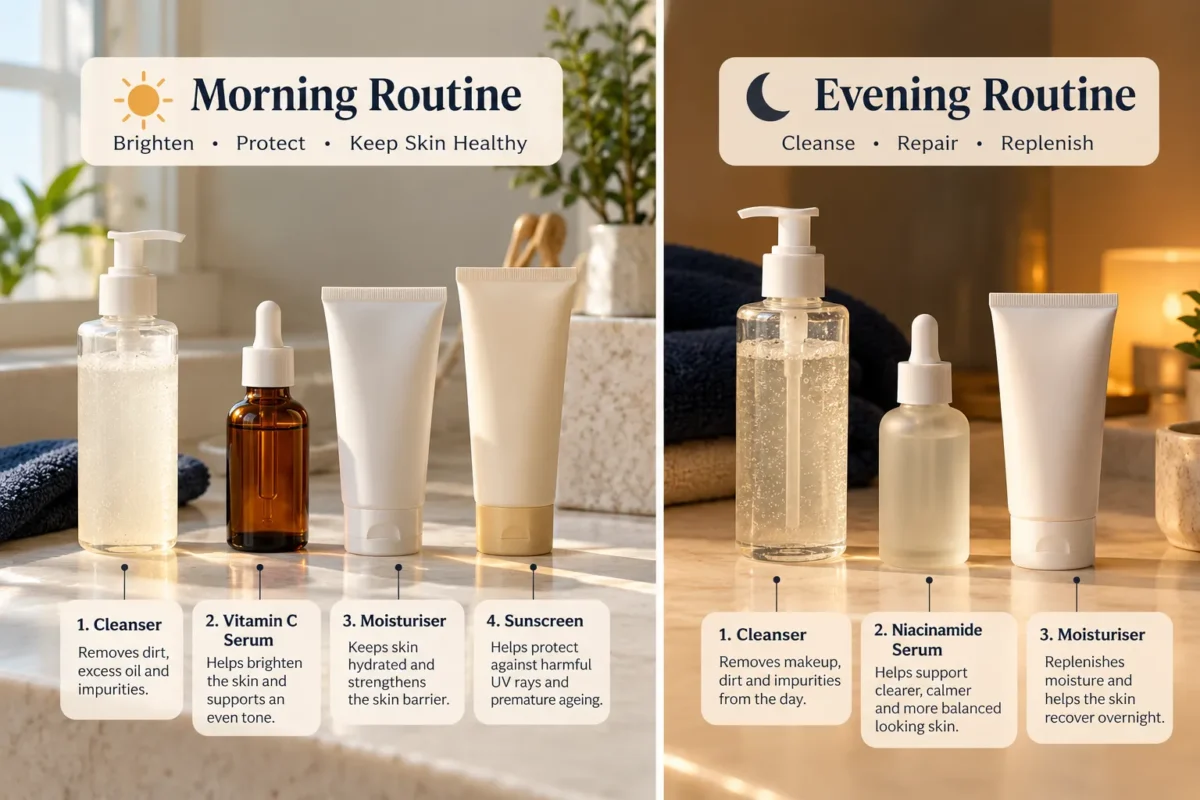
Introduce one new product at a time. Splitting vitamin C and niacinamide between morning and evening can simplify layering, but is not proof that twice as many actives produce better results.
If you already use a prescribed acne treatment, ask your clinician how a new cosmetic fits around it. Do not replace that treatment with a brightening serum on the basis of a product comparison. For an ordinary routine, begin with the product’s suggested amount and avoid adding several new products together. If layers pill under sunscreen, simplify the earlier steps rather than reducing sunscreen to make the routine feel lighter. A routine that is comfortable is easier to maintain.
Sunscreen Advice for the USA and UK
For US readers, the American Academy of Dermatology recommends broad-spectrum, water-resistant SPF 30 or higher. Sunscreens are regulated by the FDA; SPF 30 is the AAD recommendation here, not a claim that US law requires every sunscreen to have SPF 30–50.
For UK readers, the NHS advises SPF 30 or higher and at least four-star UVA protection. These are practical protection recommendations, not identical US and UK labelling systems.
Apply sunscreen separately, following its directions. Reapply during outdoor exposure, generally every two hours and after swimming or sweating. Shade and protective clothing also matter. For pigmentation concerns, tinted sunscreen with iron oxides may help with visible-light protection.
How Long Do Results Take, and When Should You Stop?
Moisturised skin may feel more comfortable before pigmentation changes. Four-week study results do not mean every dark spot disappears in a month. Harvard Health notes that vitamin C improvements can take up to three months of consistent use.
Take photographs in consistent lighting and keep the rest of your routine stable. Repeated irritation can worsen pigmentation and make progress harder to assess.
Keep a brief note of application frequency and reactions, so you can explain what changed if you later need professional skin advice.
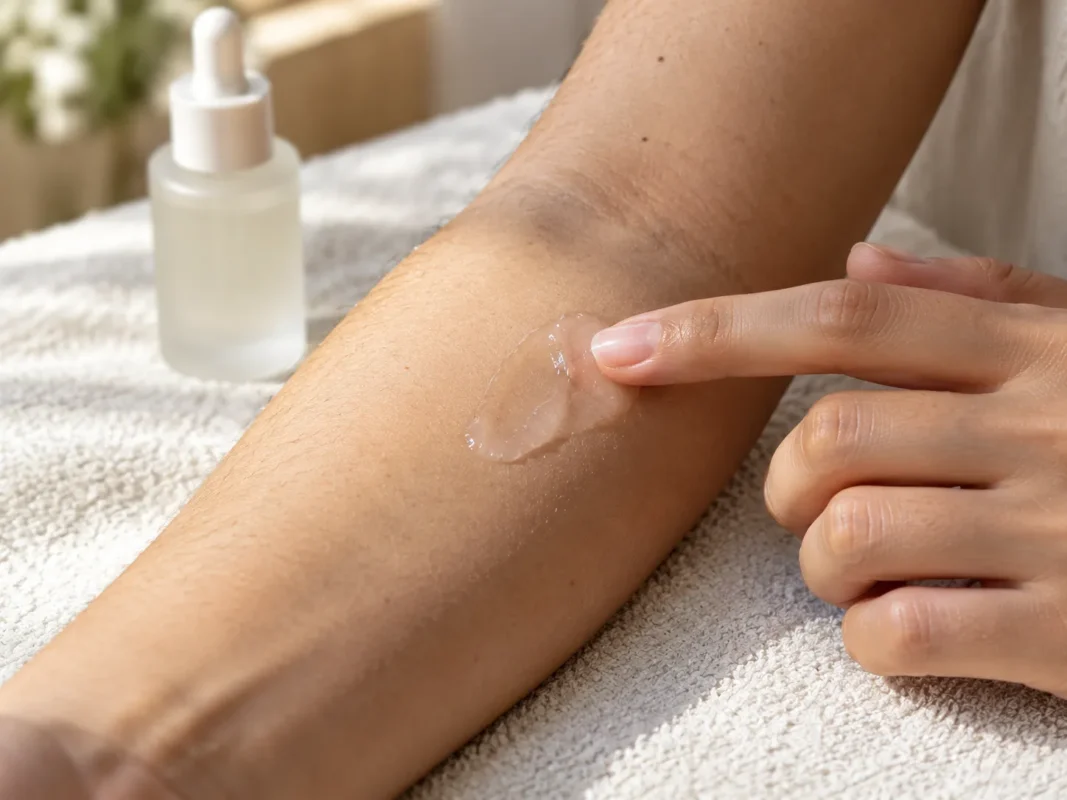
Before full use, follow the AAD’s home-testing guidance: test a small area twice daily for seven to ten days, respecting the product’s normal application instructions. This cannot rule out every later reaction.
Stop if a product causes persistent burning, itching or a rash. Seek advice if symptoms continue. The AAD’s dark-spot guidance emphasises addressing the cause; ongoing acne, eczema or irritation can keep producing marks.
Frequently Asked Questions
1. Can I Use Niacinamide or Vitamin C Every Day?
Many products are designed for daily use, but follow your product’s directions and tolerance. You do not need to use either twice daily. More frequent application is not a shortcut to results.
2. Can I Replace Vitamin C With Niacinamide?
Yes, if niacinamide better suits your concerns. Both may help uneven tone, but replacing one with the other does not provide identical antioxidant, barrier or oil-control effects.
3. Do They Whiten Skin?
The goal is to reduce unwanted uneven pigmentation, not change your natural complexion. Neither ingredient promises permanent whitening. Unexplained dark patches need assessment rather than increasingly strong brightening products.
4. Which Is Better for Acne Marks or Acne Scars?
For flat dark marks, either ingredient may be worth considering once the cause of the marks is managed. For depressed or raised scars, the question is different: a cosmetic brightening serum cannot reliably correct the altered skin structure. A dermatologist can help identify what you are seeing and discuss suitable options. New breakouts also need attention, otherwise fresh marks can keep appearing while older ones fade.
5. Can I Add Retinol, Acids or Copper Peptides?
Check each complete formula’s directions. Compatibility warnings differ, and multiple potentially irritating products can make tolerance harder to judge. Introduce products separately instead of assuming an ingredient-name “conflict checker” can certify a routine. The AAD advises avoiding retinoids during pregnancy.
6. Do Dermatologists Recommend Niacinamide?
DermNet discusses several skin benefits. This supports considering the ingredient; it does not establish that every dermatologist endorses every niacinamide product.
Three Questions to Help You Choose
- What is your main concern? Consider niacinamide for shine and barrier support, or vitamin C for dullness and antioxidant support.
- Is your skin comfortable now? If it burns, peels or reacts easily, simplify first and seek advice when needed.
- Does another product already do this job? Check your moisturiser before adding another bottle.
This is a shopping guide, not a diagnosis or prescription. Choose a formula you can tolerate, afford and use consistently, alongside sun protection.